











Welding robots with ‘Fingerspitzengefühl’
Text M. de Wit- BlokImage WeCobot, Valk Welding, Rolan Robotics
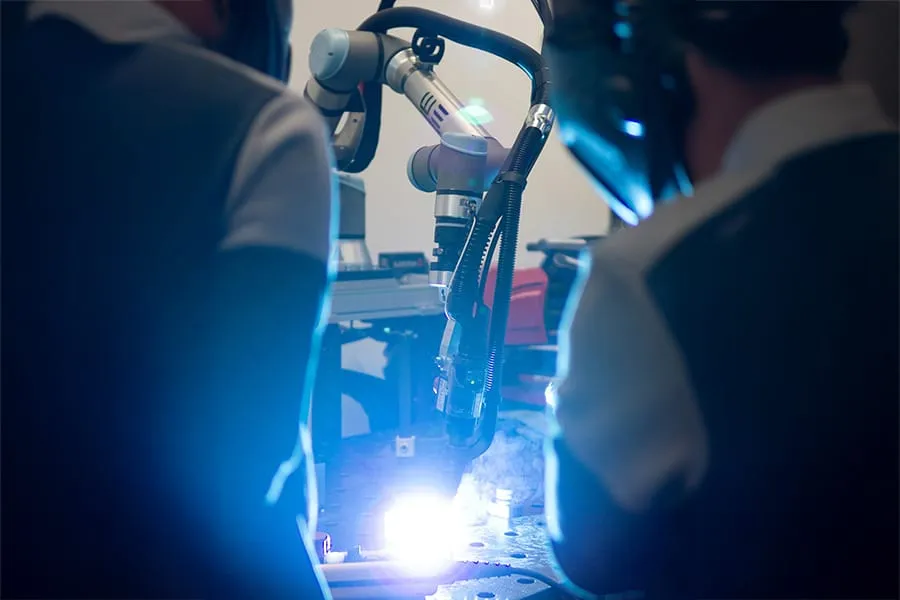
Welding robots have long been used to automate welding operations. In the early days, developments focused mainly on improving speed and accuracy. In recent years, the focus has shifted to making robots easier to programme. Thanks to this smart software, in which AI is playing an increasingly important role, programming has become a piece of cake.
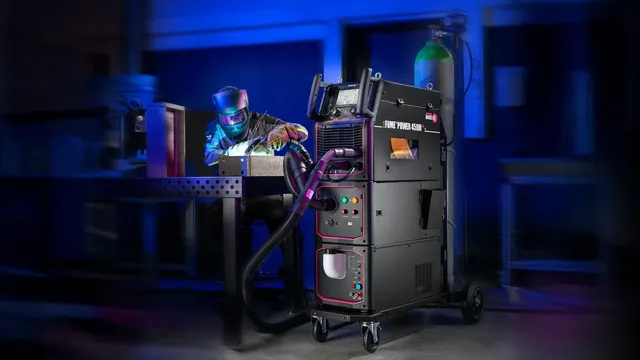
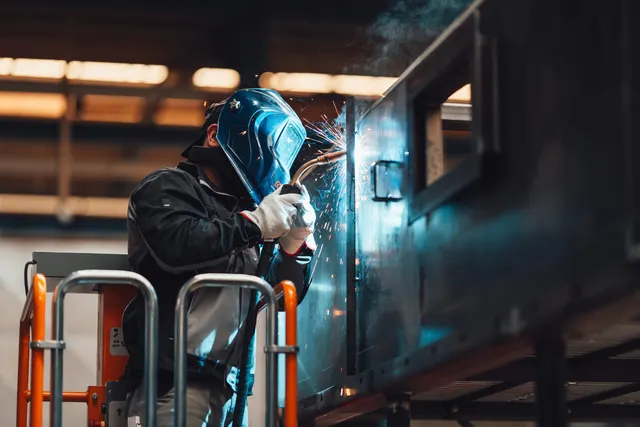
Welding robots are used not only in the automotive industry, but also in other industries, where these specialist production robots take repetitive and complex welding tasks off people’s hands. Robots have the added advantage of not falling ill, never having a Monday morning mood and working continuously, quickly and to a high standard of quality. Broadly speaking, a welding robot can weld two to three times as many metres as a person in a given period, leading to higher output.
Developments in software and AI
Given the shortage of well-trained technical staff, welding robots are becoming an increasingly important efficient and safe automation solution. Manufacturers are therefore investing in further improvements to these robots. Current developments are focused mainly on software and on simplifying or even automating programming. This is no coincidence: companies considering investing in a welding robot are often daunted by the programming work involved.
Automatically generating a welding path
The focus on this part of production preparation has led to a range of ways to simplify programming. For example, a welding path can be generated automatically from a STEP file. Depending on the welding position, the only remaining task is to add the welding parameters. In future, AI could be used to assign welding parameters to the automatically generated welding path. Other manufacturers use so-called ‘teach-in’ procedures, in which the various welding points are entered manually, after which the software creates the corresponding programme.
Putting AI to work
AI can also be used to simplify programming. The process may start with a photograph of the product, which is converted into a digital 3D image using Lidar. The required weld seams can then be selected on screen and linked to the appropriate welding parameters. AI then determines the programme needed to control the robot. AI can also be used for quality control. Modern vision systems can inspect the quality of a weld seam with a high degree of accuracy. Any detected deviations or breaches of a predefined threshold trigger an alarm. As AI capabilities continue to expand, systems may even be able to adjust the robot based on their findings, by changing the welding or geometric parameters.
Part of the production process
In many cases, welding robots do not operate in isolation but form part of an overall production process. Depending on a company’s level of automation, the processes before and after welding are also increasingly being automated. These include feeding in the material to be welded and removing finished or semi-finished products. Automating the logistics operations across the entire production process is often a longer-term undertaking, carried out in stages. After automating the handling of semi-finished products, for example, users can go on to automate the assembly of components into finished products, as well as packaging and shipping. At this advanced level of automation, it is important, among other things, for the robot to be able to communicate to some extent with the supervisory control system.
Cobots
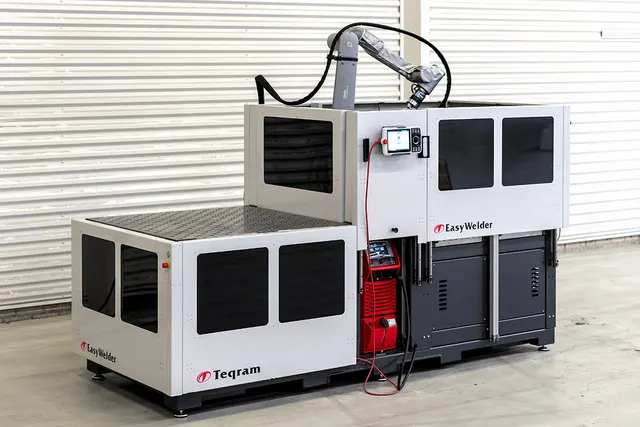
Particular attention is being paid to the development of so-called welding cobots. Cobot is a contraction of ‘collaborative’ and ‘robot’. These variants differ from industrial welding robots in that they can work alongside people. They therefore do not need to weld behind a safety fence. Instead, safety is ensured, for example, by operating at lower speeds and integrating sensors that ‘sense’ when the robot collides with people or objects, at which point it comes to an immediate stop. The hardware of a welding cobot does not differ greatly from that of an industrial welding robot. The main difference is in the software, which often makes a cobot slightly more expensive. This gives the cobot a range of distinctive functions, such as the ability to learn the required welding motion. The operator guides the cobot through the movements once, checks the programme generated from them and can then let the cobot get on with the job. This approach is particularly well suited to quickly teaching the cobot to weld simple products. In many cases, one-off items can be welded more efficiently by hand.
Complex welds
Finally, a cobot is often mobile, making it easier to bring it to the workpiece to be welded rather than moving the workpiece to the cobot. This makes it possible, among other things, to weld larger workpieces outdoors, for example offshore. Cobots can also be used to make complex welds, for example by moving in synchronisation with a moving manipulator. Applications of this kind make it possible to produce complex welds accurately without requiring a professional welder on site.
More user-friendly software
Looking ahead, manufacturers expect, among other things, an increase in orders from the defence industry, greater support from AI, more welding robots capable of laser welding and potentially even more user-friendly software to make things as easy as possible for end users.
Question about this story? Ask your question
Keep following this
Get an email when a new story is published. No account needed.
- ThemeReliable and productive welded joints
- SubjectWelding